Commentaire descriptif
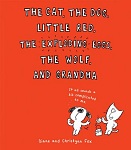
Cat starts to tell Dog the story of Little Red Riding Hood by telling him, “It’s a story about a little girl who always wears a red cape with a hood.” Dog adores stories about superheroes and wants to know what her special power is. But Cat explains, “It’s not that kind of a story.” The comical exchange that ensues is the subject of this humorous book about a frustrated cat trying to finish telling his story despite Dog’s annoying interjections, comments and questions.
The essentially plotless narrative consists of Dog’s constant criticisms of the characters’ motives and actions in the fairy tale: “I think the wolf needs to think bigger if he’s going to be a super-villain. Maybe he could rob a bank on the way to Grandma’s house.” Furthermore, he doesn’t buy that the wolf “was very happy in the end.… Are you absolutely sure this is a children’s book?”
Minimalist line drawings of the characters and a few simple props against the empty white page build a theatrical element into the story. Cat and Dog could easily be actors performing a stand-up comedy routine.
A companion to the original fairy tale and a lighthearted celebration of storytelling, this playful read-aloud will delight readers of all ages.
|
Pistes d'exploration
: Discuss the title. What elements are familiar or new? Make predictions about the story. How does your prior knowledge help you make predictions?
: What comprehension strategies do the characters use in the story? Look for examples of making connections, asking questions, retelling, predicting and other strategies good readers use.
: With a partner, read the dialogue between Dog and Cat. Use expression to convey Cat’s growing frustration with Dog. Present a page or two to the class.
: Write a version of Little Red Riding Hood inspired by Dog’s suggestions for and criticisms of the original story.
: Notice the cover, back and end pages. What type of book would you expect from these clues? Go for a picture walk. How does your vision of the book expand?
: What comprehension strategies do the characters use in the story? Look for examples of making connections, asking questions, retelling, predicting and other strategies good readers use.
: Read a different classic folk or fairy tale with a partner. Use sticky notes to add questions and comments in the same style as the story.
: This text combines superhero and fairy tale genres, uncovering and questioning the standard conventions of each. It also is an example of graphic design and multimodality in illustrated texts and can be used as a model for ways to read them by paying particular attention to both text and image as well as the use of font, layout and other elements of graphic design.
: What do you notice about the way text and image work together? How does this relationship affect your reading of the story?
: Along with other texts that combine genres, and using a production process, create a multigenre text for a select audience of children, adolescents or adults.
Mots-clés
Fairy Tale, Humour, character, dialogue, fairy tale adaptations, fractured stories, metafiction, multimodal, point of view, Red Riding Hood, speech bubbles, stance, storytelling
|