Édition papier : 9781416968023
|
PréscolairePrimaireSecondaire
|
||||||||||||
|
4ans
|
5ans
|
1re
|
2e
|
3e
|
4e
|
5e
|
6e
|
1re
|
2e
|
3e
|
4e
|
5e
|
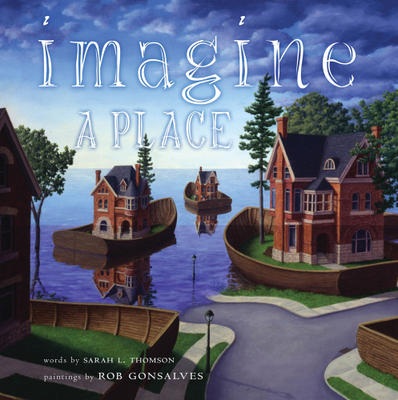
Discuss the illustrations and the way the scenes melt into each other, the poetic language and how the verse connects to the illustrations.
Predict what happened just before or just after each painting was completed.
Write a poem to accompany one of the pictures.
Perform your poem for others in a spoken word poetry format.
Before reading, look at the illustrations and predict what the text will describe. Were your predictions correct?
Consider your five senses in describing one of the places presented in the book. Imagine what you would see, hear, smell and feel. Record your ideas in a class graphic organizer.
Find an interesting or inspiring photo of a place and describe it starting with the same three words from the book: "Imagine a place…"
Write about your favourite place and include an illustration/photo. Why do you enjoy this place so much? What makes it so special to you?
What do you notice about the front and back covers? Discuss how the illustrations melt into each other; discuss the illustrator’s techniques.
Discuss the poetic language and how it connects to the illustrations. Write a new poem to accompany one of the illustrations, also beginning with the words, “Imagine a place…”
Research the illustrator’s work with surrealism. Who inspired him? Write a short descriptive paragraph of one of his optical illusion paintings. Explain your choice.
“Imagine a place where fire is cool against your skin, a glimmering echo of a star. Imagine a place where the tang of pine meets the salt of sea, where adventure finds a waiting heart.” If you imagine it, the book insists, you can go there. This companion to {Imagine a Night} and {Imagine a Day}, reminds readers, poetically and visually, that the imagination is powerful enough to carry them anyplace. Similar to the previous books, the main focus is on the full or double-page acrylic paintings, reminiscent of MC Escher in their playfulness. The images play with perspective and are infused with magical realism, making them complex and open to multiple interpretations. Each single illustration is, in fact, two pictures that transition seamlessly from one to the other. In one, a snowy mountain range morphs into the white-capped breakers of the ocean where a child, crouched on a boulder, stares out towards the horizon. Simple, but never simplistic, poetry accompanies, extends and deepens the visual imagery.
Envoyer le lien de ce titre par courriel.
Si vous préférez simplement copier-coller le lien pour votre propre usage, cliquez avec le bouton droit sur ce lien, et choisissez « Copier le raccourci» ou «copier l'adresse du lien ».
* Vous pouvez acheminer ce lien à plusieurs destinataires en séparant les adresses courriel par des virgules.
| Tweeter |