Édition papier : 9780618636877
 Format ePub : 9780547767345
|
PréscolairePrimaireSecondaire
|
||||||||||||
|
4ans
|
5ans
|
1re
|
2e
|
3e
|
4e
|
5e
|
6e
|
1re
|
2e
|
3e
|
4e
|
5e
|
Discuss the stories and explain how you think they are connected. What is the author trying to say about perspective? What is the role of newspapers in the book? Has this changed in any way in recent years?
Write the text version of the visual story of “A Waiting Game” or “Udder Chaos” (which are told mostly through illustrations).
Write a newspaper article reporting on the problem with the train. Record it to make a film/podcast.
Have a group discussion about the story. Explain how you think the stories are connected. What is the author trying to say about perspective? What is the role of newspapers in the book? Has this changed in any way in recent years?
In small group, try to find a link between the four stories: “A Waiting Game,” “Udder Chaos,” “Seeing Things” and “Problem Parents.” Tell your version of the four stories as one story to another group and compare.
Prepare a broadcast reporting on the problem with the train. Record it to make a film/podcast.
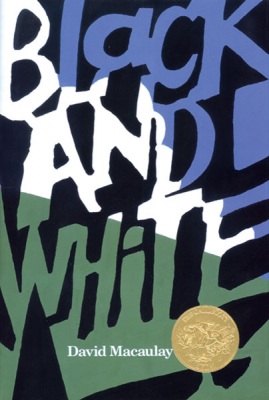
Postmodern picture books can include a non-traditional use of plot, character and setting, as well as unusual page layouts and story structures. They are constructed to challenge and engage the reader in new ways. Using a think-aloud protocol, focus on the elements that stand out on the title page and discuss their impact on the reader.
In a small group, discuss the four narratives. Interpret the meaning of each section and note the elements that support that interpretation.
Select one of the narratives and use a production process to write an article from the point of view of one of the characters.
This postmodern picture book includes a non-traditional use of plot, character and setting. Look at the first spread with the titles of each story. Discuss how you think the book should be read: as interconnected stories or separately? Why?
What do you notice about the plot, setting and main characters of each of the four stories? Why do you think the author used different graphic styles? How does the book title connect the four texts? Contrast and compare the texts while referring to all these elements.
Select one of the texts. Plan and produce an article from the point of view of one of the characters. Answer the five “W” questions. Record the final product to make a film/podcast.
“WARNING” At the start, readers are prepared for an unusual experience and given a clue to unlock the puzzle: “This book appears to contain a number of stories that do not necessarily occur at the same time. Then again, it may contain only one story.” Every spread shows four storylines. In “Seeing Things” a boy journeys by train. “The Waiting Game” depicts a crowd of would-be passengers on the platform of a station. In “Udder Chaos,” a thief attempts to rustle Holstein cows, and “Problem Parents” portrays a girl’s experience of a peculiar school night. Visual style is distinct for each story, making for an engaging array, while providing an important guide for reading eyes. The graphic black and white hide of the Holsteins interconnects with the thief’s mask and stripes. The boy’s account is rendered in dreamy watercolours, the girl’s in defined line. The genius of this book is that it asks readers to absorb information in a non-linear manner. Readers’ agile brains will leap to the task, relishing opportunities to guess at the relationship between various plot points along the way.
Envoyer le lien de ce titre par courriel.
Si vous préférez simplement copier-coller le lien pour votre propre usage, cliquez avec le bouton droit sur ce lien, et choisissez « Copier le raccourci» ou «copier l'adresse du lien ».
* Vous pouvez acheminer ce lien à plusieurs destinataires en séparant les adresses courriel par des virgules.
| Tweeter |