Édition papier : 9780763621803
|
PréscolairePrimaireSecondaire
|
||||||||||||
|
4ans
|
5ans
|
1re
|
2e
|
3e
|
4e
|
5e
|
6e
|
1re
|
2e
|
3e
|
4e
|
5e
|
Talk about vegetables that you like, and why they are good for you.
Create new names for different foods and explain where they might come from. Make a poster of your ideas and share with the class.
Create and conduct a class survey of favourite vegetables from those mentioned in the book. Extend the survey to other classes to see if the results are similar.
Talk about foods you like and don’t like.
Create new names for foods you don't like. Make a matching game of foods and their new names. Exchange with another group.
Rename a food as they did in the book. Make an ad (poster, magazine spread) to tell others about the ‘new’ food.
Little Pea, Bradley McGogg, the Very Fine Frog, I Taste, What's for Lunch?: How Schoolchildren Eat Around the World, TheFood Parade: Healthy Eating With the Nutritious Food Groups
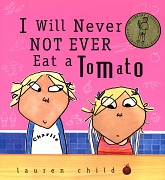
As a big brother, Charlie is sometimes asked to help look after Lola. When their parents ask Charlie to give Lola her supper, it’s especially difficult “because she is a very fussy eater.” Even the pickiest eaters will be impressed by the breadth of Lola’s distaste: “Carrots are for rabbits,” “Peas are too small and too green.” Children will appreciate the two-page spread depicting all the different foods Lola dislikes. Photography of real food is incorporated into the images along with appealing sketches to encourage early readers to sound out words such as spaghetti and sausages. The language starts out rhythmic, using repetition to set up the story. As he reaches among the kitchen shelves, Charlie tells his sister, “We are not going to eat any peas, or carrots, or potatoes . . . . There will be no cauliflower or cabbage . . . and certainly no tomatoes.” With some mild subterfuge and a verdant imagination, Charlie introduces a whole new meal for the wary Lola. Carrots become “orange twiglets from Jupiter,” while what may look like fish sticks are actually “ocean nibbles . . . mermaids eat them all the time.” The story’s theme of sibling bonding is underlined by its charming finish, when Lola wants to taste her own food-invention—one of those big, ripe, red, juicy “moonsquirters”. Lola responds to her big brother’s surprise: “You didn’t think they were tomatoes, did you Charlie?”
Envoyer le lien de ce titre par courriel.
Si vous préférez simplement copier-coller le lien pour votre propre usage, cliquez avec le bouton droit sur ce lien, et choisissez « Copier le raccourci» ou «copier l'adresse du lien ».
* Vous pouvez acheminer ce lien à plusieurs destinataires en séparant les adresses courriel par des virgules.
| Tweeter |