Édition papier : 9780688109905
|
PréscolairePrimaireSecondaire
|
||||||||||||
|
4ans
|
5ans
|
1re
|
2e
|
3e
|
4e
|
5e
|
6e
|
1re
|
2e
|
3e
|
4e
|
5e
|
Discuss what you dream about. How are your dreams different from your life?
Tell the story of the dream as a class, with each student having a chance to add his/her ideas.
Choose an illustration from the book and write what could happen next or what could have just happened.
Discuss what you dream about. Who is in your dreams? How are your dreams similar to real life? What happens if you fall asleep while reading a book?
Make a class list of things you see in the pictures. Use resources to find the meaning of unknown words.
Make a class book telling what happened in the boy’s dream. Work in groups, with each group writing part of the story. Remember to use connecting words.
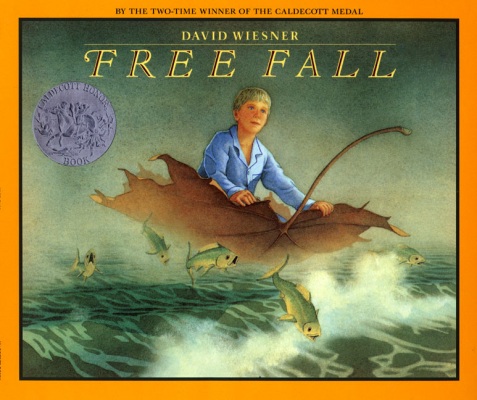
The first illustration of a boy asleep in bed, a leather-bound book splayed out on his chest, sets the tone for this ethereal, wordless story. When we see the book blown open on the next page, we understand that we are now immersed in the boy’s dream world, which morphs fantastically from one spread to another. The pages of Free Fall are filled with extremely detailed, finely wrought watercolour drawings of mysterious and fantastical scenes. Many have fairy tale elements: a castle, a knight, a dragon, a temple or white swans. The calming colour palette features earth tones and soft blues. Because the illustrations are presented without text, the reader is invited to create his or her own explanation of the events that are unfolding, reinforcing the message that when it comes to imagination and brainstorming, there are no “right” or “wrong” interpretations. The last page, which shows the boy awake in the morning, surrounded by the everyday items that were so magical in his dreams, opens the door to a discussion of what we dream about and why.
Envoyer le lien de ce titre par courriel.
Si vous préférez simplement copier-coller le lien pour votre propre usage, cliquez avec le bouton droit sur ce lien, et choisissez « Copier le raccourci» ou «copier l'adresse du lien ».
* Vous pouvez acheminer ce lien à plusieurs destinataires en séparant les adresses courriel par des virgules.
| Tweeter |