Édition papier : 9781908473066
|
PréscolairePrimaireSecondaire
|
||||||||||||
|
4ans
|
5ans
|
1re
|
2e
|
3e
|
4e
|
5e
|
6e
|
1re
|
2e
|
3e
|
4e
|
5e
|
Introduce the concepts of nouns and adjectives. Create a T-chart listing all the nouns and adjectives in the book.
Draw a picture of your favourite food. Show your illustration to a friend; see if he or she can guess what you drew. Give your friend some clues if necessary.
Name the five tastes associated with our taste buds. Sample foods that are either salty, sweet, bitter or sour and play a game of “What’s that flavour?”
Compare the illustrations on the right and left sides of the book. What do you notice? How are the illustrations connected?
Use a diagram chart to sort pictures of foods (clipped from supermarket flyers) that are sweet, salty, sour, bitter, cold and hot. Use labels.
Draw something tasty and something that is not tasty. Explain your choices to the class; “I like the taste of___, but I don’t like the taste of___.”
Discuss which pictured items you have tasted and which you have not. Are there any you would like to try? Survey the class and see who agrees. Display the results on the chalkboard or a poster.
Put food samples of into opaque containers and have classmates guess the mystery foods. (N.B.: beware of allergies and resistance to unfamiliar foods).
I Will Never Not Ever Eat a Tomato, Eating the Alphabet: Fruits and Vegetables From A to Z, TheFood Parade: Healthy Eating With the Nutritious Food Groups
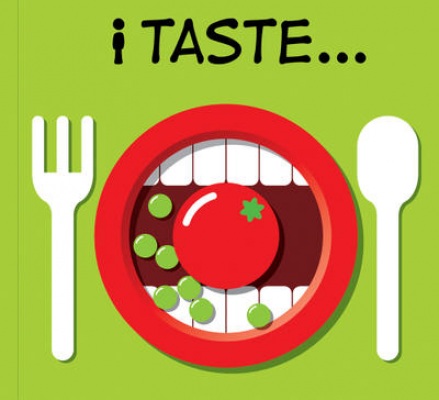
Beginning with the phrase “I taste . . .” this book addresses a range of taste sensations for young readers (“cheesy pizza,” “something spicy”), while touching on the different ways other creatures taste (“with my fins,” “with my feet”). Bright graphic images almost conjure up different tastes for readers, and highlight their contrasts. In one spread, someone’s spaghetti transforms into a bird’s worm. In another, a tongue doubles as a lollipop (“sweet”) while the facing image shows the same tongue shape sticking out in a grimace, on a lemon-shaped face (“sour”). Some transparencies also provide young readers with flip-fun by changing and embellishing illustrations on either side. Through both language and image, whether the taste invoked is pleasant (“fresh fruit”) or scary (“your blood!”), this book will inspire thoughts, conversation—and even, possibly, the discovery of some new taste sensations.
Envoyer le lien de ce titre par courriel.
Si vous préférez simplement copier-coller le lien pour votre propre usage, cliquez avec le bouton droit sur ce lien, et choisissez « Copier le raccourci» ou «copier l'adresse du lien ».
* Vous pouvez acheminer ce lien à plusieurs destinataires en séparant les adresses courriel par des virgules.
| Tweeter |