Édition papier : 9780152244361
|
PréscolairePrimaireSecondaire
|
||||||||||||
|
4ans
|
5ans
|
1re
|
2e
|
3e
|
4e
|
5e
|
6e
|
1re
|
2e
|
3e
|
4e
|
5e
|
Create your own fruit and vegetable alphabet book using images from flyers. Use both upper and lower case printing, as modelled in the book.
Survey the class: which of the illustrated fruits and vegetables are class favourites? Which are liked or disliked the most? Which would they like to try? Sample some of the less familiar ones.
The inside cover page illustration resembles a face. Research an artist named Arcimboldo. Create an art piece using cut-out images of fruits and vegetables.
Discuss the foods presented on each page. Which ones have you tried before? Which would you like to try?
Brainstorm for fruits and vegetables not found in the book. Create a classroom poster with these, including illustrations and labels.
Use a T-chart to classify the illustrated foods as either fruits or vegetables.
Draw and label a face (or a basket) using 10 of your favourite fruits and vegetables. Hint: See beginning of the book for ideas . . . .
I Taste, Alphabeasts, TheFood Parade: Healthy Eating With the Nutritious Food Groups
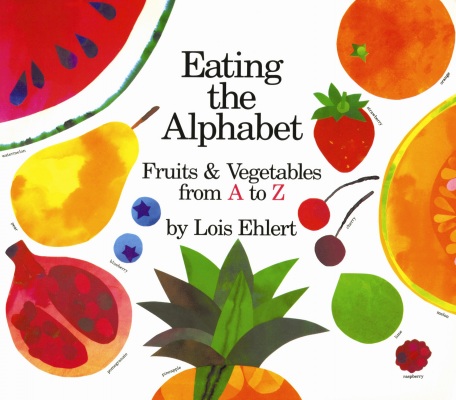
Bright and colourful, this alphabet book will create appetite and curiosity around familiar and unusual fruits and vegetables. Urging young readers to “Start eating your way through. . .” the alphabet, the text is largely the names of fruits and vegetables, each of which is spelled out in both upper and lower case letters. Images painted and collaged in rich colours use graphic, defined forms to depict a range of edibles for every letter in an artful yet recognizable manner: “apricot, avocado, apple, asparagus.” Gorgeous watercolour markings create bruises on bananas, purple veins on a beet leaf, and leaves on a Brussels sprout. Children will see the outside and inside of figs, and onions in multicolour (red, yellow and green). The cornucopia also includes the less familiar jicama, okra, quince, radicchio and many more. A glossary offers interesting background information on each plant: “RHUBARB (ROO-bahrb). . . The stalk is edible, but the leaf is poisonous.” This beautiful book may inspire trips to the market, as well as exploration of unfamiliar foods.
Envoyer le lien de ce titre par courriel.
Si vous préférez simplement copier-coller le lien pour votre propre usage, cliquez avec le bouton droit sur ce lien, et choisissez « Copier le raccourci» ou «copier l'adresse du lien ».
* Vous pouvez acheminer ce lien à plusieurs destinataires en séparant les adresses courriel par des virgules.
| Tweeter |