Édition papier : 9781403478719
|
PréscolairePrimaireSecondaire
|
||||||||||||
|
4ans
|
5ans
|
1re
|
2e
|
3e
|
4e
|
5e
|
6e
|
1re
|
2e
|
3e
|
4e
|
5e
|
Discuss the features of non-fiction books. Review the words in the glossary before reading. Why are glossaries important? What are the benefits of having a table of contents and an index?
Brainstorm a list of foods that can be made using apples. Create a day’s menu using only apple-related foods.
Choose an apple recipe and reproduce it on a board or chart paper. Discuss the importance of following a recipe.
Create a T-chart with the headings Sweet and Sour. Taste a variety of apples and categorize them accordingly. List other descriptive words for apples.
Compare the life cycle of an apple with that of another fruit. How are they similar? Different?
Discuss the features of non-fiction books. Review the words in the glossary before reading. Why are glossaries important? What are the benefits of having a table of contents and an index?
After reading the book, but before turning to page 28, draw a timeline for an apple. Then compare yours to the one in the book.
Research foods made with apples. Create a day’s menu, using only foods that contains apples.
Compare varieties of apples, noting their distinctive characteristics.
Design a poster (print or virtual) that highlights the features of different types of apples.
Read a tall tale about Johnny Appleseed.
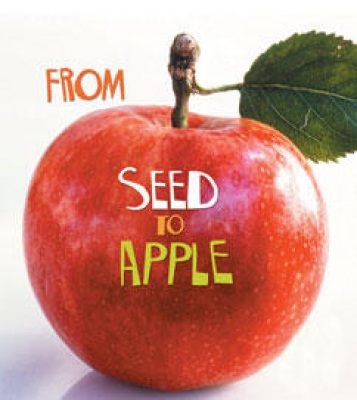
This book is filled with pretty photos of shiny apples, orchards and seasonal scenes. Brief language in large type teaches young readers about basic plant reproduction and growth. The lush green spread on photosynthesis (“Leaves and Food”) manages to convey its information in five short sentences. Words in boldface type are defined in a glossary at the back. Attractive quality photographs show images such as bees pollinating apple blossoms (“Making Seeds”), a caterpillar munching a leaf (“Insect Pests”), and a bird pecking away at windfalls (“Apple Picking”). Throughout, seed-shaped sidebars ask leading questions for conjecture and discussion: “Why do some apples have holes in them?” Answers are nearby in the text. End material includes a diagram showing the life cycle of an apple, pull-point diagrams of apple and apple tree anatomy, recommended reading and a simple index. For getting children started in natural science reading and research, this book is a very engaging choice.
Envoyer le lien de ce titre par courriel.
Si vous préférez simplement copier-coller le lien pour votre propre usage, cliquez avec le bouton droit sur ce lien, et choisissez « Copier le raccourci» ou «copier l'adresse du lien ».
* Vous pouvez acheminer ce lien à plusieurs destinataires en séparant les adresses courriel par des virgules.
| Tweeter |