Édition papier : 9780374316983
 Format ePub : 9781466895089
|
PréscolairePrimaireSecondaire
|
||||||||||||
|
4ans
|
5ans
|
1re
|
2e
|
3e
|
4e
|
5e
|
6e
|
1re
|
2e
|
3e
|
4e
|
5e
|
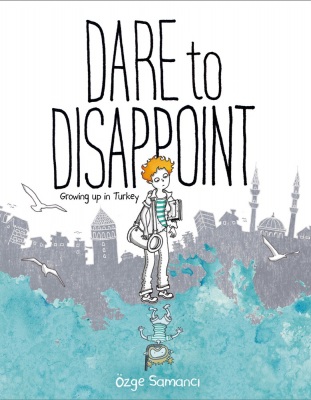
Consider the graphic novel’s cover, title page and splash page. What do these peritextual (outside the text) elements tell the reader about the type of text they will be reading? Who or what is this graphic novel about? What kind of story might this be? Brainstorm early predictions and record them to refer to later.
How do text and image work together to convey meaning? Discuss how one supports the other and the effect they have on the story.
Select key personal and social/political scenes in the text. How do they work together? Produce a short graphic text that combines personal memories and social/political movements.
Make predictions based on the title, subtitle and cover.
Choose one page from this graphic memoir and rewrite it in the form of a traditional comic strip. Explain what techniques make the memoir or comic strip easier or more difficult for you to read. Support your explanation with examples.
Create a memory album for Özge: one page as a child in Turkey, one page as a teenager and one page as a university student. Add a page about schooling in Turkey which includes facts from the book and from your own research.
Security, comfort, acceptance: these are what Dad wants for his girls. “In this country, if you are a woman and you don’t have a job, you are a ZERO, nothing. NOTHING!” Vivid language combines with a visual mashup of comics and collage to create an engrossing tale of Özge’s journey from child to young adult. Politics provide plenty of external pressure. Raging inflation helps ignite tensions between westernsecular and easternreligious factions (both imposed with totalitarian authority). Diagram-style images, maps and illustrated lists explain socio-economic trends with humour, while charming comics depict the effects on young people’s lives. One image shows a regional map, with radio waves emitting from Athens, Greece, toward Özge’s coastal town of Izmir. A caption reads: “Greek television … used to show more cartoons than Turkish TV.” Pig-tailed little Özge watches rapt—chin in hands, feet kicking the air—and thinks, “Our enemies love kids more than Turks.” Through all this, an imperfect yet loving family dynamic is portrayed with nuance and sensitivity, as Özge struggles toward an understanding of her own identity as a budding artist, learning to “swim against the current!” Rich language, image, and an ingenious approach to partnering the two make this graphic memoir an original treasure.
Envoyer le lien de ce titre par courriel.
Si vous préférez simplement copier-coller le lien pour votre propre usage, cliquez avec le bouton droit sur ce lien, et choisissez « Copier le raccourci» ou «copier l'adresse du lien ».
* Vous pouvez acheminer ce lien à plusieurs destinataires en séparant les adresses courriel par des virgules.
| Tweeter |