Édition papier : 9781570913488
|
PréscolairePrimaireSecondaire
|
||||||||||||
|
4ans
|
5ans
|
1re
|
2e
|
3e
|
4e
|
5e
|
6e
|
1re
|
2e
|
3e
|
4e
|
5e
|
Listen to the Danse Macabre music a few times (CD is included). Notice the pictures that come into your mind as you listen. In small groups, compare and contrast how you visualized the music.
On a picture walk, note the different settings and characters, and make predictions. Compare these to the actual story as it is read aloud.
Discuss the creative process used by the composer. Draw a mind map of the different stages of the process. Compare it to the writing process you use in class.
Imagine walking in the catacombs, a notebook in hand. Write about your thoughts, feeling and imaginings, then write a piece of poetry in the same style as the book.
Listen to the Danse Macabre music a few times. Take notes of the pictures that come into your mind as you listen. In small groups, compare and contrast how you visualized the music.
Go for a picture walk, look at the different settings and characters, and make predictions for the story. As the story is read aloud, compare and contrast your predictions with the story.
Discuss the creation process used by the composer. Draw a mind map of the different interventions throughout the process. Compare it to the writing process you use in class.
Research the catacombs of Paris. With a partner, discuss whether you would visit them or not. Be sure to elaborate on your answer and question your partner’s.
As you read, take note of the parts that are grounded in reality and those that seem supernatural. Why do you think the author combined the two? Did she do a good job merging them?
Write a review of Camille’s Danse Macabre, as though you were sitting in the audience at the Theatre du Chȃtelet on January 24, 1875.
Learn to Speak Music: A Guide to Creating, Performing & Promoting Your Songs, My Story, My Dance: Robert Battle's Journey to Alvin Ailey
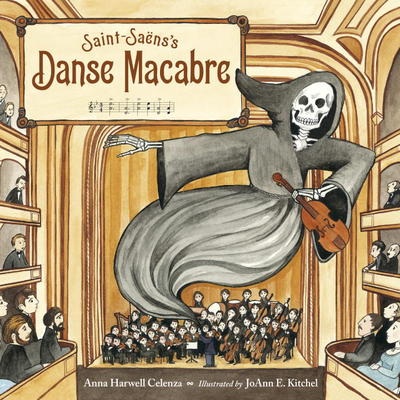
Part of a series on classical composers, this one focuses on Camille Saint Saëns and his trip to the catacombs in Paris in 1872, where he found inspiration for his now famous symphonic piece, Danse Macabre. The biographical story travels from the Paris underground to a dinner party where the work is first performed, and to the concert hall, where the music evokes skeletons that transport the listener back to the source: a graveyard, and “Maestro Death” himself. Rich language is dense and often takes liberty with conversations and descriptions that go beyond the original biographical material. This makes for a colourful and narrative-driven read. “‘I wanted to capture the rasp and jangle of waltzing skeletons,’ he told Henri. ‘That’s why I added Xylophones to the orchestra.’” Evocative words—ossuary, amorously, diabolical—are peppered throughout. Pastel watercolours fill the double-page spreads and are most adept at capturing the skeletons and graveyard scenes. A particularly striking image shows a skeleton in a black cloak holding a violin, rising up in a swirl out of the music in the orchestra pit to the ceiling of the concert hall. Depictions of human characters are more one-dimensional, but possess a naïve charm and reflect details of the period. Marvellous notes at the back describe how the composer used tuning and bowing techniques to create haunting effects and evoke death’s “haunting fiddle.” Includes a CD recording of the piece.
Envoyer le lien de ce titre par courriel.
Si vous préférez simplement copier-coller le lien pour votre propre usage, cliquez avec le bouton droit sur ce lien, et choisissez « Copier le raccourci» ou «copier l'adresse du lien ».
* Vous pouvez acheminer ce lien à plusieurs destinataires en séparant les adresses courriel par des virgules.
| Tweeter |