Édition papier : 9781629790992
|
PréscolairePrimaireSecondaire
|
||||||||||||
|
4ans
|
5ans
|
1re
|
2e
|
3e
|
4e
|
5e
|
6e
|
1re
|
2e
|
3e
|
4e
|
5e
|
Voir et faire autrement
Benny Goodman & Teddy Wilson: Taking the Stage as the First Black and White Jazz Band in History
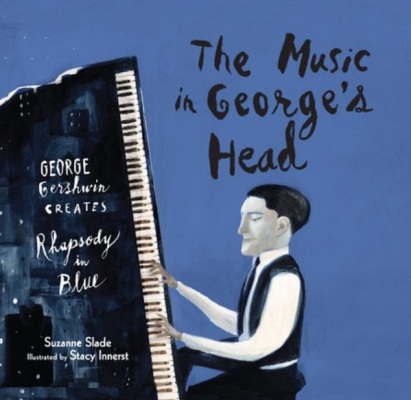
This picture-book biography of George Gershwin introduces young readers to the life and major influences of the famous American composer. The book is prefaced by an epigraph that cites Gershwin: “I frequently hear music in the very heart of noise.” The narrative pivots around that ability, which characterizes George’s talent and composition style even from a young age: he hears music everywhere—in the din of the city, in the clatter of train wheels. He manifests an early interest in the piano, and takes in all the music he can, in any and every style. When he begins to compose, he borrows freely from a number of musical genres but also lets in that “noise.” The story culminates with the premiere of his famous “Rhapsody in Blue,” a mix of classical music, ragtime, jazz, and blues that is “a musical kaleidoscope of America’s melting pot.” The text is aptly ornate—for instance, “the notes were restless, untamed”—and plays with figuration and sound, with “velvety violins” and “jazzy razzmatazz” echoing the rhythms George hears, and the mellifluous melodies he is striving to create. The biography provides some context, mentioning for instance the bandleader Paul Whiteman, and the illustrations suggest influences such as Bessie Smith and Duke Ellington. The accompanying illustrations are all sweeping brushstrokes in shades of blue that riff on the title of Gershwin’s seminal concerto. The acrylic paintings give a sense of the early twentieth century, with appropriate street settings, transportation, vaudeville theatres, and dress and hairstyles. Music is ever-present: George is shown roller-skating to school as a ream of notes unfurl from his ear, sitting on the bus plucking notes from the air, and pacing around a grand piano as he tries to compose. Key musical moments include George’s introduction to Harlem jazz clubs and the premiere of “Rhapsody in Blue.” Many scenes are compositionally hybrid, mixing reality and more allusive or symbolic representation: “George finished his concerto” shows the sheet music flying out over the New York skyline, the piano keys extending to become a path on which a train chugs by, while a Klezmer musician plays the clarinet, and a construction worker jackhammers alongside the jazz greats and a tap-dancing couple. Traditional typeface is used alongside unruly handwriting and cursive in various sizes and directions, sometimes even replicating musical notation, and increasingly so as George finds his place and shapes the musical landscape of the time. An author’s note at the end of the book provides a factual overview of Gershwin’s short life and expands the picture book’s plot to include George’s extensive musical collaborations with his brother Ira. A timeline and selected bibliography are also included.
Envoyer le lien de ce titre par courriel.
Si vous préférez simplement copier-coller le lien pour votre propre usage, cliquez avec le bouton droit sur ce lien, et choisissez « Copier le raccourci» ou «copier l'adresse du lien ».
* Vous pouvez acheminer ce lien à plusieurs destinataires en séparant les adresses courriel par des virgules.
| Tweeter |
Pistes pédagogiques|
PréscolairePrimaireSecondaire
|
||||||||||||
|
4ans
|
5ans
|
1re
|
2e
|
3e
|
4e
|
5e
|
6e
|
1re
|
2e
|
3e
|
4e
|
5e
|
Learning Intention
Students will explore how descriptive sensory language is effectively used to engage the reader’s senses, helping them feel present in the story.
Links to the Program of Study - English Language Arts – Secondary Cycle One
Reader, Text, Context: Interpreting Texts
o Identifies features, codes and conventions used to achieve a recognized social purpose and/or function and/or effect and impact on self as reader (QEP, p.115).
Exchanges With Other Readers:
o Discusses aesthetic and efferent readings of texts by indicating where [they] focused [their] attention and interest (QEP, p. 115).
Exchanges With Other Readers
o Situates [their] responses within the text, i.e. rereads (QEP, p. 115).
Context (Before Reading)
1. Allow students to use their devices to research George Gershwin, having them write down two interesting facts that they learned about his life. Ask volunteers to share these with the class. Provide quick biographical information about the artist, adding to students’ findings.
2. Share a definition of descriptive sensory language and the five senses it engages.
3. Provide a model sentence that uses sensory details to describe the classroom and what is happening in the moment. Ask students to identify the sensory details.
Procedure (During Reading)
4. Read the book once for enjoyment and to help generate background knowledge.
5. Working with a partner, students take a sheet of paper and draw an outline of George’s head. One can even be traced from the first page of the book.
6. Ask students to re-read the text in pairs, going back over each page, looking for any descriptive language that effectively describes how George sees music or the world around him. Place these descriptive words or phrases inside their drawing of George’s head.
7. Show students the beginning of your model of “inside the mind of George”. The first page tells you that George hears music in “the very heart of noise.” Write that point inside his head. A second example, on p. 9, explains that “when he felt those smooth piano keys, his face lit up like the lights on Broadway.” Add this descriptive sentence.
8. Give students time to fill in “the mind of George” with the descriptions they notice.
Integration (After Reading)
9. Ask the students to circle three examples of descriptive language that really drew them into the story as a reader.
10. Ask students to share their choices in small groups, explaining how the descriptions effectively drew them into the story. Ask students to identify whether these were example of seeing, hearing, tasting, smelling or feeling, or a combination?
11. Ask students to independently draw an outline of their own head on a sheet of blank paper. Get students to describe a particular hobby they love. Challenge students to use descriptive language that activates all the senses and places a reader right there in the moment.
12. Provide an example of your own to show students. (E.g. Hiking is a hobby I love, I put it in the centre of my head and then proceed to share all the things I see, I hear, I smell, I taste, I feel when doing this.)
13. Provide time for students to share in small groups or hold a gallery walk.
Extensions
1. Write a short descriptive narrative that zooms in on a time when you were engaged in your hobby. Slow down the moment, so that readers can see, hear, taste, feel and smell what is going on around you (e.g. scoring a goal in a championship soccer tournament, baking your favourite muffins, riding your bike, hunting for the first time, etc.).
Links, Resources, References
o Copibec: https://www.copibec.ca/en/agreement-elementary-highschool
Pedagogical application created in collaboration with Western Quebec School Board